
Why Three AI Labs Suddenly Started Building Scientific Infrastructure
Anthropic, OpenAI, and Google tackled different problems but all point to the same shift toward trustworthy AI-generated science


5 min read • From reproducibility to peer review, here’s how frontier labs are reshaping scientific AI.
In a single week, Anthropic, OpenAI, and Google shipped three separate science-related announcements.
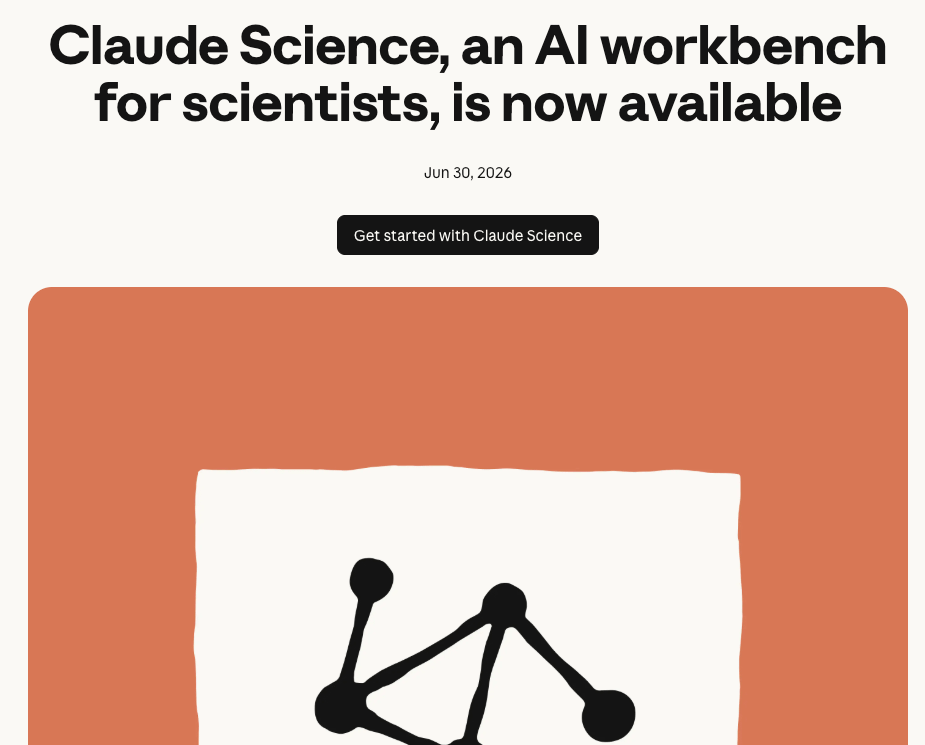
Anthropic released Claude Science, an AI workbench for researchers.
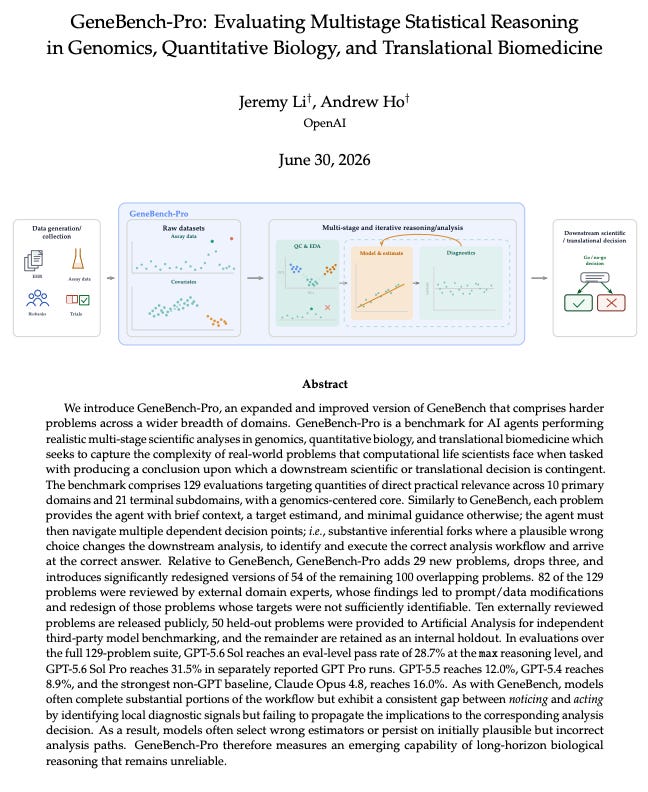
OpenAI released GeneBench-Pro, a benchmark for measuring scientific judgment in AI models.
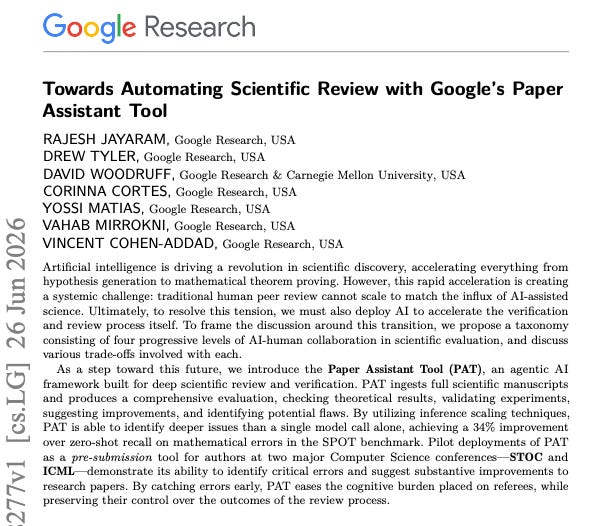
Google Research published PAT, an agentic system for reviewing scientific manuscripts before submission.
None of these labs coordinated. None of these products depend on each other. But the convergence points to something real: generating scientific work is no longer the hard part.
The harder problems are making AI-generated science measurable, reproducible, and verifiable.
The pressure building underneath
AI has demonstrably accelerated scientific research production. Models can analyze genomic datasets, generate protein structure predictions, and draft manuscripts. Researchers are using these tools on real problems right now.
But production acceleration creates downstream pressure. When AI can run a full analysis pipeline and produce publication-ready outputs, the questions that follow are harder than the generation itself.
Can the analysis be reproduced? Are the intermediate steps correct? Does the model make sound scientific judgments when data is ambiguous? Who catches errors before they enter the literature?
PAT’s paper makes the scale of this pressure concrete: submissions to flagship AI conferences grew from 17,051 in 2020 to an estimated 73,883 in 2026.
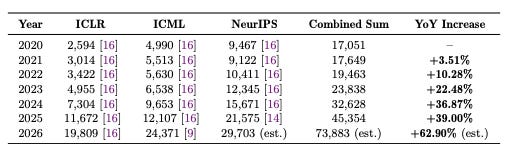
Human peer review, which in theoretical computer science requires line-by-line verification of dense proofs over multiple days per paper, cannot scale to match this volume.
Each of the three launches addresses a different piece of this downstream pressure.
Claude Science
Claude Science integrates the fragmented tools of scientific research into a single environment.
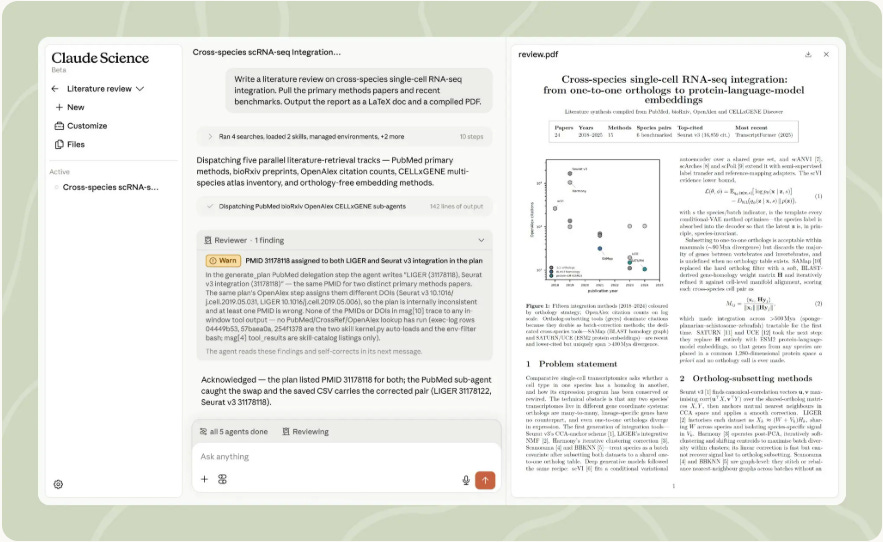
Specialist agents query across sources including UniProt, PDB, Ensembl, and ChEMBL. The system manages compute, scales analyses across HPC clusters, and connects to life sciences models through NVIDIA’s BioNeMo toolkit.
One recurring theme throughout the announcement is reproducibility.
When Claude Science generates a figure, it includes the exact code and environment that produced it and the full message history.
A reviewer agent runs continuously, checking citations, flagging untraceable numbers, and identifying figures that don’t match their underlying code.
The reproducibility infrastructure is what makes the productivity gains trustworthy rather than merely fast.
Jérôme Lecoq at the Allen Institute used it to produce around ten computational reviews, each over 100 pages, that would previously have taken his team up to two years each. Actor-critic pairs ran throughout: one agent creating content, a separate reviewer evaluating it for accuracy and citation fidelity.
Stephen Francis at UCSF ran comprehensive germline workups across multiple approaches in roughly one-tenth the previous time, with independently validated results.
GeneBench-Pro
OpenAI’s GeneBench-Pro addresses a different question: not whether AI can execute scientific analyses, but whether it can make the judgment calls that separate good science from bad science.
OpenAI calls this “research taste”: the chains of judgment calls that shape an analysis.
Which questions the data can actually support. When an initial plan needs to be revised. When a result is decision-ready. Most existing benchmarks test workflow execution or fact recall. GeneBench-Pro tests judgment under ambiguity.
129 problems across 10 computational biology domains.
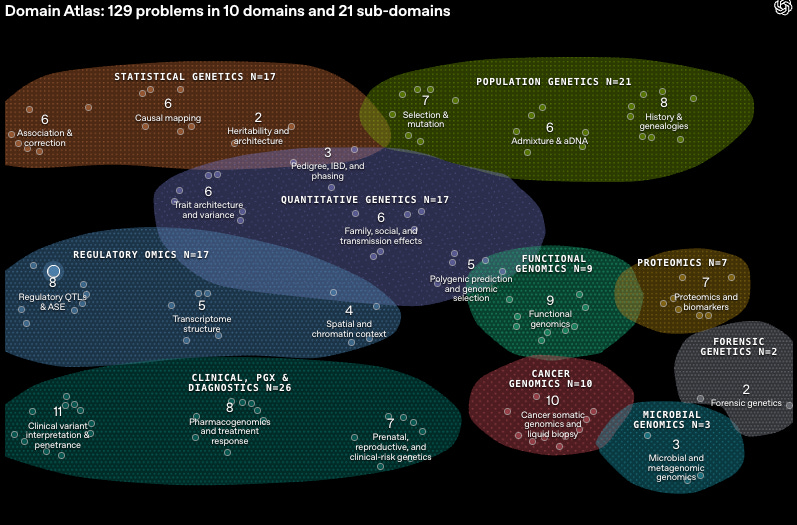
Each built synthetically with a known causal structure so correctness is deterministic. External domain experts estimated each problem would take a human expert 20-40 hours.
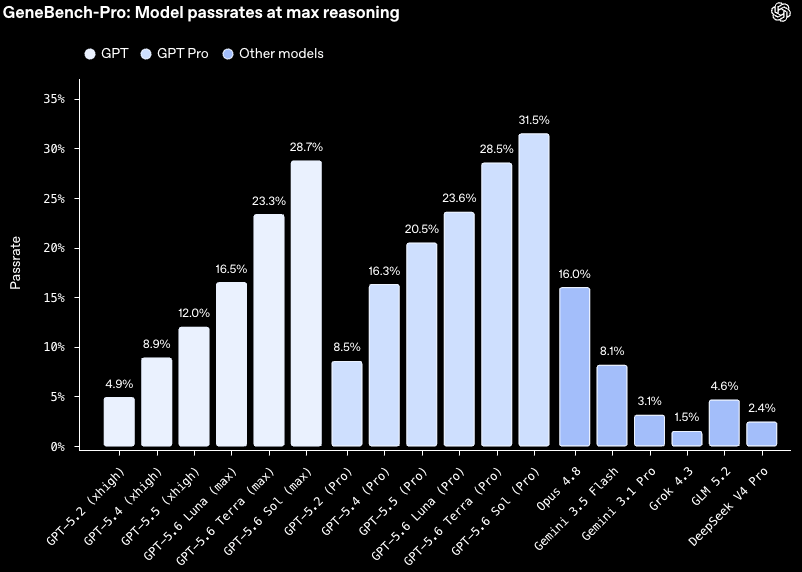
The best current result: GPT-5.6 Sol at 31.5%.
Progress has been rapid. The best model scored below 5% when the original GeneBench was built. But fewer than a third of problems solved by the best available model means AI scientific judgment is not yet reliable enough for autonomous high-stakes research decisions.
The gap between GPT models and open-source alternatives is also significantly wider here than coding benchmarks would predict, suggesting scientific reasoning is a harder and more distinct capability than most benchmarks reveal.
PAT
Google Research’s Paper Assistant Tool addresses the furthest downstream problem: catching errors in manuscripts before they enter the literature.
PAT was piloted as a pre-submission tool for authors at STOC and ICML. It ingests full scientific papers and produces comprehensive evaluations, checking theoretical results, validating experiments, and identifying potential flaws.
A segmenter agent breaks papers into logical components. An adaptive budgeting layer allocates more compute to complex sections. Deep review agents work in parallel. A synthesis agent deduplicates findings and grounds claims against external search.
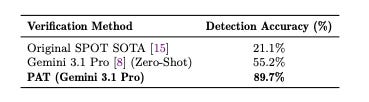
On the SPOT benchmark (papers containing verified errors that led to retractions), PAT achieves 89.7% recall on mathematical and proof errors. Zero-shot Gemini 3.1 Pro achieves 55.2%. The prior state of the art: 21.1%.
Authors caught critical errors before submission. The goal is to ease cognitive burden on human referees while preserving their control over review outcomes. AI acts as a first-pass filter, not a replacement.
The pattern underneath all three
These systems don’t work together and weren’t designed to. But examined together, they reveal something the individual announcements don’t make explicit.
Every one of them introduces an AI agent whose primary job is to check another AI agent.
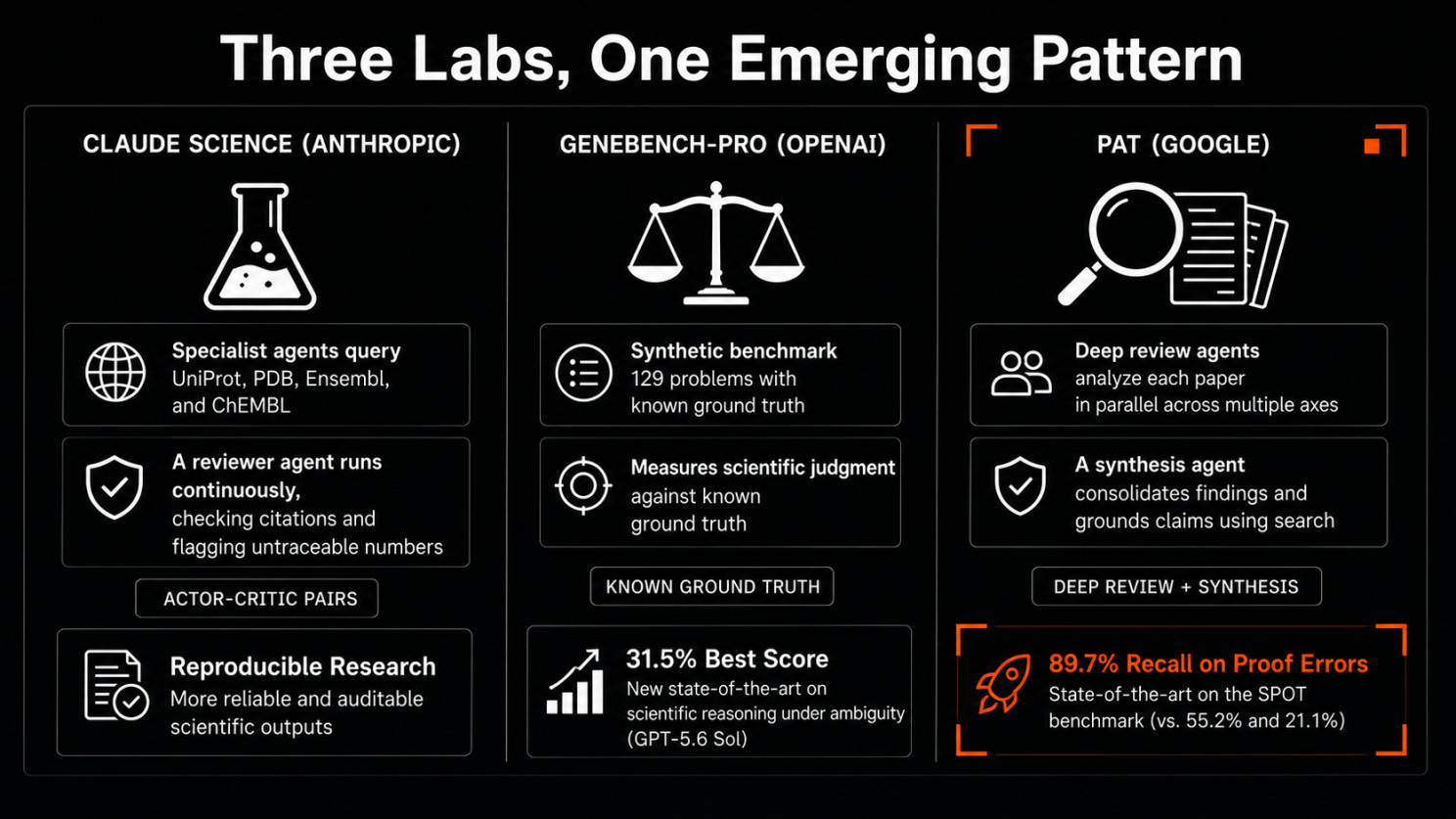
Claude Science ships a reviewer agent that continuously monitors what the main agent produces. Lecoq’s use case made this concrete: actor-critic pairs running throughout, one agent creating, a separate agent evaluating.
PAT is built almost entirely on this principle. Deep review agents checking the outputs of models that wrote the papers. A synthesis agent checking the review agents for duplication and hallucination.
GeneBench-Pro operationalizes the same philosophy at the evaluation level: rather than trusting a model’s self-assessment of its scientific judgment, it creates an external measurement system that determines whether that judgment was actually correct.
Different implementations. The same underlying bet: single frontier models cannot be trusted to validate their own outputs in high-stakes scientific contexts.
This is the more significant shift underneath the individual product announcements. Generating scientific work is increasingly within reach. What isn’t solved is whether anyone can trust the results.
These three labs are independently concluding that trust requires layers of measurement and critique built on top of the models themselves, not just better models.
None of these systems attempts to solve scientific autonomy outright. Instead, they add layers of measurement, reproducibility, and verification around increasingly capable models.
That may be the more significant trend than the models themselves: rather than assuming better generation will naturally produce trustworthy science, frontier labs are increasingly investing in the infrastructure that constrains, measures, and checks what those models produce.
Sources:
GeneBench-Pro: https://openai.com/index/introducing-genebench-pro/
Claude Science: https://www.anthropic.com/news/claude-science-ai-workbench
PAT paper: https://arxiv.org/abs/2606.28277
Check out https://alphasignal.ai/newsletter to get a daily summary of the latest breakthrough news, models, papers and repos. Read by 300,000+ devs
Failed to authenticate. API Error: 401 {"type":"error","error":{"type":"authentication_error","message":"Invalid authentication credentials"},"request_id":"req_011CcbwavNX7saijpwVHQqEN"}